
The Electrical Safety Standards in the Private Rented Sector (England) Regulations 2025 have now been extended to encompass the social rented sector, marking a significant shift in statutory obligations for registered providers of social housing.
New scope
Previously applicable only to private landlords, the Regulations now apply to registered providers of social housing. This amendment aligns safety standards across both sectors, ensuring consistency in tenant protection.
Implementation dates
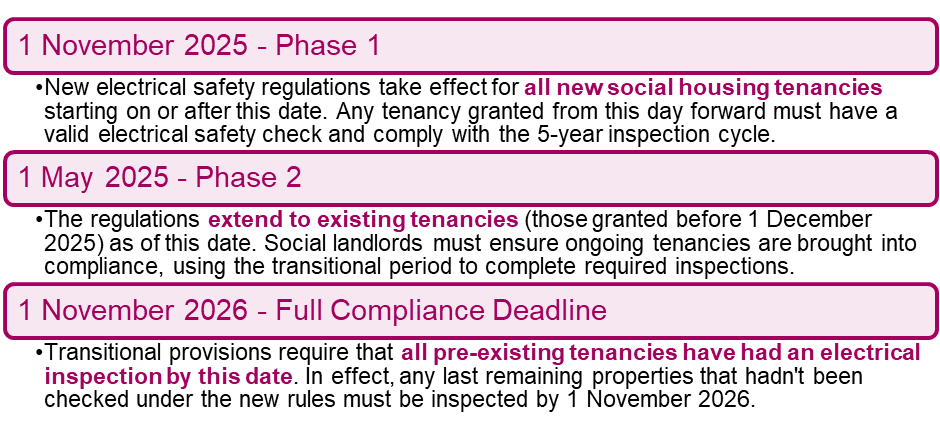
The Regulations come into force in two phases. From 1 November 2025, they apply to all new tenancies granted on or after that date. From 1 May 2026, they extend to cover existing tenancies that were granted before 1 December 2025, giving registered providers a transitional period to bring previous arrangements into compliance. By 1 November 2026, all pre-existing tenancies are required to have completed an electrical inspection in accordance with transitional requirements. Properties that have not yet been inspected under the new regulations must be checked by this deadline.
Key requirements
Registered providers must:
-
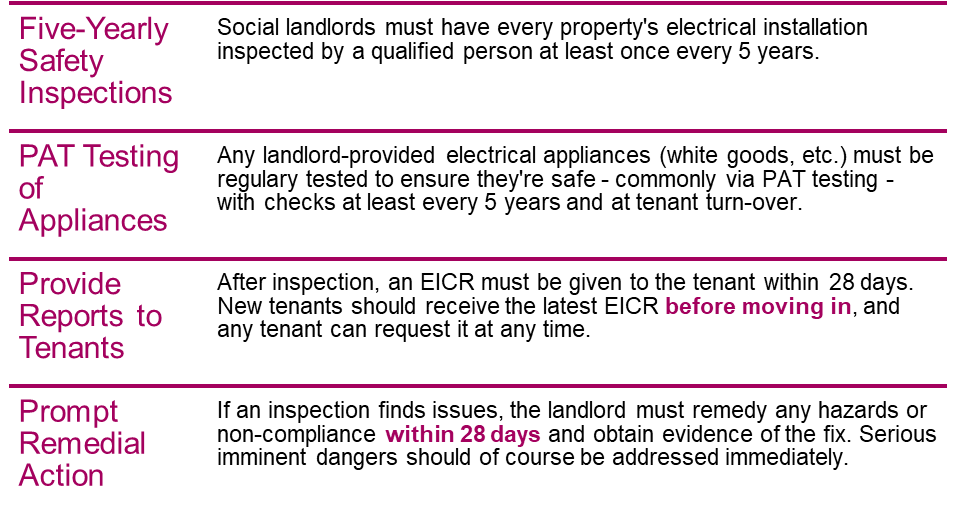
Ensure electrical installations are inspected and tested at least every five years by a qualified person.
-
Provide tenants with a copy of the Electrical Installation Condition Report (“EICR“) within 28 days of the inspection.
-
Undertake PAT testing (In-service Inspection and Testing of Electrical Equipment) on all electrical appliances provided under the tenancy.
-
Complete any remedial works identified during inspection within 28 days.
For existing tenancies as of 1 May 2026, if a valid EICR is already in place but has not yet been provided to the tenant, the provider must supply the report to the tenant by this date, regardless of whether a new inspection has occurred. Prospective tenants may request the EICR, which landlords must provide within 28 days.
The obligation to provide an EICR applies only to the individual properties let under a tenancy. There is no requirement to provide tenants with EICRs for common parts of blocks, although these areas must still comply with other statutory safety obligations.
Compliance steps
To meet these obligations, providers should:
-
Audit existing inspection regimes to identify gaps.
-
Update internal procedures to ensure timely inspections and circulation of reports.
-
Train staff and contractors on the new statutory requirements.
-
Maintain robust records of inspections, reports, and tenant communications.
Risks of non-compliance
Failure to comply with the regulations may expose registered providers to enforcement action by local authorities, including formal notices and potential legal proceedings. Financial penalties may be imposed under tenancy law, particularly where breaches affect tenant safety or infringe statutory obligations. Moreover, reputational damage is a significant risk, especially in the current climate of heightened scrutiny following high-profile incidents such as the Grenfell Tower fire and the tragic death of Awaab Ishak, both of which have heightened the importance of robust housing standards and regulatory compliance.
In addition to local authority enforcement, failure to comply may also amount to a breach of the Safety and Quality Standard, which replaced the Home Standard from 1 April 2024. The Regulator of Social Housing may take regulatory action under the Housing and Regeneration Act 2008, including issuing enforcement notices or downgrading governance ratings, where providers fail to meet their health and safety obligations.
Practical guidance
To support compliance and minimise disruption, registered providers should develop accessible checklists that clearly outline inspection and reporting requirements. Internal communication must be streamlined to ensure all relevant departments are aware of their responsibilities and timelines. Additionally, proactive tenant engagement strategies should be implemented to facilitate access for inspections and enhance tenant understanding of the process and its importance.
Relevance and operational impact
This regulatory extension is not merely procedural; it has direct operational implications. Providers must act promptly to embed these requirements into their asset management and tenancy processes. Legal teams should work closely with housing and compliance officers to ensure readiness ahead of the November and May deadlines.
Compliance with electrical safety standards also contributes to the Tenant Satisfaction Measures (“TSMs”), especially those concerning tenant safety and overall satisfaction. Failure to comply may negatively impact published TSM scores and regulatory assessments.
Contact us
Our social housing sector supports social housing providers across England and Wales with all legal issues affecting the sector. Our legal experts are happy to support you with any ongoing or upcoming issues, including the above. If this is something you would like a better understanding of, get in touch today.
Researched and co-authored by Matthew Burgess and Millie Singleton